The Washington Nationals stirred up some publicity earlier this morning by beginning the sale of single-game tickets for one singular series, May 4-6 versus our beloved Fightin’ Phils. It wasn’t the odd practice of only releasing one series’ worth of tickets to the general public that caught headlines, it was the fact that these tickets were limited to folks with credit cards from the DC-metro area, intended to “Take Back the Park” to block out Phillies fans.
The Nationals are quietly stockpiling nice, primarly young and developing talent to help them ascend to the top of the NL East. And that ascension may come quicker than Phillies fans realize: just yesterday, Buster Olney tweeted that the Phillies would win the NL East and that the Nationals would win one of the two Wild Card spots. As teams like the Tampa Bay Rays and Oakland A’s have found, making the playoffs does not always fill up the stadium. But announcing a rivalry with the top dog and telling their fans they can’t come to the games? That will grab headlines and that will fill the seats.
Wally Bryson is one of my favorite guitarists ever. He’s got a great sense of timing and a terrific, whimsically-bright sound that can change on a dime to a much harder, driving edge. The way he navigates the guitar makes him perhaps the penultimate 70’s power pop guitarist. After the Raspberries dissolved, Bryson teamed up with members of the Rascals to form Fotomaker. “Can I Please Have Some More” is one of their signature songs off of their first record, 1978’s self-titled effort.
If you liked this jam, you may like the following similar jams I’ve been jamming to:
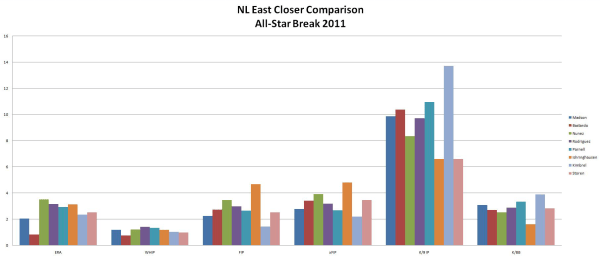
Antonio Bastardo leads all Major League pitchers at the All-Star Break with an .82 ERA and only trails the Padres’ Mike Adams and the Orioles’ Koji Uehara for the Major League lead in WHIP. With Tuesday’s trade of Fransisco Rodriguez to the Milwaukee Brewers, there was one less, at the very least, once-dominant closer in the NL East. With K-Rod’s departure, there was likely even a more clean-cut best closer in the NL East; do Bastardo’s video-game-like numbers pass the test to take the role? Click on the chart below to enlarge.Bastardo at least finds himself in the discussion by the easy-to-digest ERA and WHIP stats. He leads all NL East closers (which for the sake of this post includes Ryan Madson, Antonio Bastardo, Leo Nunez, Francisco Rodriguez, Bobby Parnell, Jason Isringhausen, Craig Kimbrel and Drew Storen) in those categories. But when peripherals are thrown in the mix a few conclusions can be drawn:
1.) Francisco Rodriguez was not nearly effective this year as he was in previous years, nor as effective as he was perceived to be;
2.) Jason Isringhausen is not the guy Mets fans want closing for them;
3.) Bobby Parnell has been, very quietly, one the best middle relievers in Major League Baseball, able to strike batters out, but struggles with walks. He should be the Mets’ closer;
4.) Ryan Madson was having a terrific season before he injured his hand;
5.) If the Marlins can get a decent return for Leo Nunez at the deadline, they should do it;
6.) Antonio Bastardo’s peripherals mirror his performance and you shouldn’t expect a huge fall-off;
and
7.) Craig Kimbrel is the best closer in the NL East, probably the entire NL.
First, the trade of Rodriguez was a very smart move for the Mets. They avoid his gigantic option and are able to give an opportunity to a young player, Parnell, who has been successful this year in striking batters out. His 2.92 ERA is lower than both Rodriguez and Isringhausen, outpaces both in relatively large margain in FIP and xFIP, and creates a lot of swings and misses. If he can limit the walks, he would be an excellent choice to close as the Mets look to rebuild. Next, Madson of the Phillies was having a tremendous season before his untimely hand injury. He had very solid K/9 IP and K/BB rates, a 1.19 WHIP, and posted a 2.03 ERA despite being relatively unlucky (.316 BABIP v. .228 BAA). Nunez feels like the Marlins closer by default and ranks at or near the back of the pack in each of the statistical categories, conventional or advanced, for NL East closers. Bastardo’s other-worldly ERA and WHIP is not something that will balloon into the 3’s any time soon, but he is on quite a historic pace, as written about earlier here. He has a .101 BAA which closely matches an impressive, or lucky depending on ow you see it, .130 BAPIP. His penchant for giving up fly balls may catch up to him, but he is making hitters swing and miss as well. However, Bastardo has done this in only 33 innings. He has been perfect in only 5 chances but does have 7 holds in 36 appearances. Craig Kimbrel, meanwhile, is on another level.
Kimbrel may not have the flashy sub-1 ERA Bastardo carries, but he has done his work in 13 more innings over 11 more appearances. Kimbrel has been worth 2 Wins Above Replacement level player (WAR) this season, .6 WAR more than the next closest Major League reliever (teammate and fellow All-Star Jonny Venters). His 2.35 ERA is only good enough for 17th in the NL, behind teammates Venters and Eric O’Flaherty, but his FIP leads all NL closers, pacing the next closest closer, Joel Hanharan, by .7. Where Kimbrel really shines is his 13.70 K/9 IP, which leads all NL closers and trails only Kenley Jenson of the Dodgers for the NL lead. Like Parnell, Kimbrel would benefit from reducing his walks, but his 3.89 K/BB is still good enough far and away to lead all NL East closers and good for third among all NL closers. The scariest part? His .181 BAA versus his .305 BABIP suggests that hitters are finding holes that better defenses would reach. Meaning with a little bit of defensive luck, Kimbrel would have even better stats.
Kimbrel is only 23 and is in his first full season. His 46 innings pitched is 31.2 away from his career high attained last year between Triple A and Atlanta. His success is scary for Phillies’s not only this year, but for years to come. The silver-lining for Phillies’ fans this year? Kimbrel and teammates Venters and O’Flaherty, two All-Stars and a third I wouldn’t have blinked an eye on if selected, are all on pace to either surpass or outright blow away their previous career high in innings pitched. Despite his five blown saves, Kimbrel has been far and away the best and most consistent closer in the NL East this season and looks to be, along with Venters, a thorn in the side of Phillies fans for years to come. If the Braves can maintain his arm and effectiveness, I would dread facing the Braves and their stellar bullpen in a potential NLCS match-up.
“Garageland” by The Clash is a pretty hip track off of their self-titled debut album that concludes their critically acclaimed first album. The song appears to be a reflection of the rising interest in the group as they made a name for themselves and the challenges of building and maintaining an identity that truly represented themselves while signing with a major label. It is my favorite tune off of their first album.
If you liked this jam, you may like the following similar jams I’ve been jamming to:
This year, the Phillies are sending four All-Stars to Arizona with a possibility of a fifth if Shane Victorino can win the final vote. Cole Hamels, Roy Halladay, Cliff Lee, and Placido Polanco will all wear the red pinstripes next Tuesday and all are veterans of the Midsummer Classic; Hamels and Halladay have represented the Phillies once each, while both Lee and Polanco represented different teams in the American League after being traded, but before being reacquired, by the Phils. Four Phils All-Stars would be the most since they sent five in 2009 and Victorino’s inclusion would match that mark. It is only the 2nd time in the last 10 seasons that the Phillies will send four players to the All-Star game. If Victorino is voted in, it will match the record for Phillies All-Stars in a single game, matching efforts of 2009, 1995, 1981, 1979, and 1976.
Here’s what the last 10 years of Phillies’ All-Stars looked like (click to enlarge):
Not too many surprising names on that list. I had forgotten that Vicente Padilla and Tom Gordon were All-Stars as Phillies and thought Jim Thome made more than one in a Phillies uniform. The Phils have been well represented in the last 11 seasons; they average 2.63 players per game and have had no less than 3 All-Stars per game since 2005. While it may not be surprising to hear that the Phillies have had 29 unique appearances in the All-Star game since 2001, what may be surprising is that they have signed or traded for 29 All-Stars, which includes Cliff Lee twice, since 2001 as well including four in each of the last three seasons (click to enlarge):
Of the 29 former All-Stars acquired, only 7 made the All-Star team with the Phillies after being acquired while both Dave Hollins and Ricky Botalico had previously made the All-Star team with the Phillies and were later reacquired. Of the players acquired, only a few were reasonably expected to be All-Stars. The Phillies got as-advertised players with Halladay, Lee, Jim Thome, Brad Lidge, and Billy Wagner, while Tom Gordon was a bit of a pleasant surprise. While Jose Mesa did not make the All-Star team with the Phillies after being acquired, he pitched very well as the Phillies’ closer. Jose Contreras has exceeded expectations and has been excellent out of the bullpen and Jamie Moyer was a pivotal part of the Phillies’ transformation into a World Series club. Some of the players acquired, including but not limited to Ronnie Belliard, Luis Castillo, Mike Sweeney, and Jeff Conine were no-harm, no-foul acquisitions while others cost the Phillies players who would mature into top talent.
For instance, the acquisition of Freddy Garcia cost the Phillies two pitchers who have pitched well in the past few seasons: Gavin Floyd and Gio Gonzalez. Gonzalez is headed to his first All-Star game this year after being incredibly effective for the Oakland Athletics. He is one of eight players that the Phillies have either traded or released from 2001-2011 that have made the All-Star game after departing the Phils (click to enlarge):
Of those players, the Phils have since reacquired Lee and only Michael Bourn and Gio Gonzalez appear to be long term assets that would help the Phillies in 2011 and beyond. Between 2001 and 2011, the Phillies have seen the departure of most of the All-Stars that they have acquired, but the positive take-away is that in recent years, they have been able to retain the All-Stars that have been the most productive from their own system. They haven’t traded away too many future All-Stars and the ones of value that they did, they either received an All-Star in return or the verdict is still out. Some trades have been better than others and their are two major clunkers that stick out that luckily did not sink the Phillies and were the right moves at that time: the 2006 trade of Bobby Abreu and the 2007 trade of Gio Gonzalez and Gavin Floyd for Freddy Gonzalez. The Thome for Rowand swap in 2006 filled a need and opened up a spot for Ryan Howard, while the Michael Bourn trade addressed the closer and utility roles that ultimately helped win them a championship.
With the heatwaves hitting Philly and its surrounding suburbs, we’re keeping the lyrics light and the beats uptempo this week. At the tail end of my “cutting” program, i.e. a light diet and a high reps, light weight program, and I need the music to help get me through it!
“Pulling Mussels (From the Shell)” by Squeeze is a song that just when I think I have figured out the meaning, I hear something new in the song that makes me think twice. Anecdotaly, it seems be one of the most mislabeled, misheard songs in the history of music; it is also a song that everyone has probably heard a few times but doesn’t know who it is or what the title of the song is. The song reached 44 on the U.K. charts in May 1980 but did not chart in the U.S. It was released on their 3rd album Argybargy.
If you liked this jam, you may like the following similar jams I’ve been jamming to:
A lot has changed in a year and I am grateful for the positivity, peace, and prosperity that has found me. I have spent much of it with my best friend who became my fiance, I went from grad school graduate to part time retail to career, I dropped from 36% body fat to 11%, losing over 45 lbs and 7 inches off my waist, and I went from local TV singer to, well, nothing. With just about all of the I’s dotted and T’s crossed, that last part will change back to the better, too.
With work on our new show starting up, I was reviewing some of the old shows to see what went wrong, what went right, and to enjoy living in 2010, a year that ended as well as any I can remember. This site features some of our bonus material that we recorded. I screen-capped my favorite moments of the highlight reel for posterity sake below. You’ll find Kris, Ray, Mike, Joe, Jason, Josh, and Andy having the time of our lives. Enjoy.
(To view our back catalog of episodes, please click here. For screen caps of episode one, please click here.)
The Sweet were half-bubblegum, half-glam, all awesome. Their questionable attire and silly lyrics made them easy targets but also allowed them to sell a lot of records in the UK. While “Ballroom Blitz” is undoubtedly their most well-known song by contemporary audiences, “Fox on the Run” was equally successful, reaching number 2 in the US, UK, Canada, Ireland, the Netherlands, and Norway, and number 1 in Australia, Denmark, Germany, and South Africa and it powered their album Desolation Blvd.to number 25, their highest charting album, in the U.S.
If you liked this jam, you may like the following similar jams I’ve been jamming to:
I'm the proud owner of an Antonio Bastardo shirsey. I have a rooting interest in this.
It was June 2, 2009. The Black Eyed Peas were in the beginnings of a 26-week stranglehold of the number one American Billboard spot. Up was number one at the box office with the Hangover debuting the coming Friday. The Phillies entered the day a half game behind the Marlins, winners of four-in-a-row, and were preparing to play the middle game of a three game set in San Diego.
Stretched thin by injuries, relative ineffectiveness, and ten games in ten days, the Phillies called on 23-year-old lefty Antonio Bastardo to start against the Padres. Bastardo had split time between the bullpen and starting to start the season in Reading, posting an impressive 10.2 K/9 IP and a very good 5.86 K/BB rate. Bastardo was called upon to replace the injured Brett Myers; he was greeted with hype and enthusiasm, but seen as short, with a deceptive delivery and a plus-change-up to induce strikeouts. Coincidentally, the scouting report used for the purposes of researching this article comparEd Bastardo to the recently-released J.C. Romero for their ability to get strike-outs and their inability to prevent walks. As noted this year, Romero struggled keeping the opposition off the base-paths and was supplanted by Bastardo as the primary left-handed set-up man.
Bastardo has flourished in the first three months of the season, posting an MLB-relief leading .96 ERA in 28 innings over 31 games. He’s averaging 10.6 K/9 IP and has limited his H/9 IP to 3.5. His walks remain a concern at 4.2/9 IP, almost a half an inning as does his scary low (in a bad way) 28.3% GB rate. The low ground ball rate coupled with the ridiculously lucky .153 BABIP are scary in that if line-drives begin to drop or fly balls begin to go over fences, Bastardo, obviously becomes a far less valuable bullpen piece. But this article isn’t to discuss the possibility of the bottom falling out, which it may. It is to explore the realistic chances of Antonio Bastardo making the NL All-Star Game.
The Arguments For Antonio Bastardo Making His First NL All-Star Team:
He leads all MLB relievers in ERA.
This may be his strongest asset and perhaps his most vulnerable. He has pitched the equivalent of just over three full games, meaning, every 9 innings, he gives up a run. But that could quickly turn sour. An earned run in his next inning pitched would skyrocket his ERA to 1.24. 2 in the next three innings pitched and it would jump to 1.45. Both still very impressive, but because of the rarity of non-closer relievers making the All-Star game, the ERA would need to hover near 1.00 due to the low number of innings and appearances. Or would it?
Of the ten pitchers in the last ten seasons to be named to either All-Star team, NL pitchers finished the year with average ERAs of 1.91, giving Bastardo some leeway to earn an All-Star bid.
He has stranded 99.1% of the batters inherited or put on on base.
This one is rather impressive on the surface. He is fourth in the NL in WHIP (0.86) among relievers and the guys he does let on base simply do not score. But it also has a lot to do with the luck he has received in BABIP, of which he is the third largest beneficiary of MLB relievers.
He leads the MLB in BAA.
Can’t particularly argue with this one and it helps put the incredibly lucky BABIP into perspective. Perhaps it isn’t so lucky. His BAA is .117 and isn’t that far off from his .153 BABIP.
There are more pitchers on the All-Star teams today than there were in 2001.
Last season, the NL had 16 pitchers, the AL 18 compared to 11 on each side for 2001.
There are a number of teams who will only send 1 All-Star to the All-Star Game and most likely won’t be relievers.
It’s tough to project any more than a handful of teams receiving more than one All-Star. The Phillies will have 3, likely 4. The Braves may have two; Brian McCann is a lock and Craig Kimbrel will likely get in. A possibly of a third, either Eric O’Flaherty or his much-hyped pen mate Jonny Venters are also worthy candidates. The Marlins and the Mets will have to send someone. The Nats will send Mike Morse with Tyler Clippard possibly sneaking in or taking the Nats automatic bid. Milkwaukee, Cincinatti, and St. Louis will likely send 2-3 each, Pittsburgh is likely just Andrew McCutchen but may send Joel Hanrahan. After that, LA, SF, and AZ are the only other teams with reasonable chances to send two or more players. Liberally, that puts the NL All-Star roster at 31; conservatively 25. Last year’s NL All-Star team was 40 strong, after injuries and pitching rules were enforced. The big roster works in Bastardo’s favor.
The Case Against Antonio Bastardo
The Phillies will already be sending at least three, possibly four players to the All-Star game.
Gone are the days of one team taking over the All-Star game. It is doubtful that we will again see an All-Star team with 9 players from one team in the near future like the historic 2001 Mariners, or even 7 like the contemporary 2001 Yankees squad. It’s not an exact science, but teams in the last 10 years in the NL that have sent a middle reliever have sent, on average, 2.5 players including the reliever to the All-Star game. Placido Polanco will win the vote at Third Base, Roy Halladay and Cole Hamels are as close to locks as you can get, and Cliff Lee is doing everything and more to earn a deserved NL All-Star birth. This is among the least compelling, and probably the weakest, argument to keep Bastardo out of the game but with the mandate that each team needs an All-Star, the numbers crunch could be the last hurdle Bastardo needs to clear.
Jonny Venters is/was/is perceived to be unstoppable.
Until he looked mortal this past weekend, Jonny Venters was a one-man wrecking crew. While not a strikeout machine like some of the other attractive middle relief candidates (only 9.37/9 IP) and not as capable with control (3.31 BB/9 IP), the walk number is still better than Bastardo. His ERA, 1.29, is good for 5th in the NL, and only 2nd best on his own team behind Eric O’Flaherty, but the hype machine is hot and heavy for the exceptional Venters. Teammate Brian McCann should reach Arizona easily, which may hurt Venters’ chances of being an All-Star via the number crunch.
As the manager of the World Series champs, Boche has major influence as to who gets on to the All-Star squad. Sergio Romo has been fantastic once again this year and is averaging 3 more strikeouts/9 IP, gives up a third of the walks/9 IP, and leads the MLB relief world in xFIP by .55.
Tyler Clippard, Mike Adams and a big numbers game.
The Tyler Clippard/Mike Adams road block is tied closely to the “Each Team Needs One Representative” squeeze Bastardo faces. Clippard and Adams have been recognized as the best set-up men in the MLB this year and have the stats to prove it. Adams himself will probably be squeezed out by Heath Bell for the lone Padres representation.
Conclusion:
Antonio Bastardo has unquestionably pitched like an All-Star this year but picked a year of excellent middle relief performances to attempt to make the All-Star game. Positively, the NL recognized relievers last year, sending 3 middle relievers to the Midsummer Classic. For Bastardo’s best chance to make the 2011 All-Star, it would help to pick up a few saves while he has the opportunity to as closer to display his versatility while Ryan Madson is out but more importantly, root for the following to happen:
Root for Andrew McCutchen and against Joel Hanharan
Root for Mike Morse and against Tyler Clippard
Root for the Braves relief corp to get rocked
Root for a Sergio Romo meltdown
That obviously would provide the best chance for Bastardo to make the 2011 NL All-Star team. But if the NL All-Star team was picked today, I think Bastardo would be included.

 Bastardo at least finds himself in the discussion by the easy-to-digest ERA and WHIP stats. He leads all NL East closers (which for the sake of this post includes


