“In The Morning” comes from U.K. band Razorlight‘s 2006 self-titled album, their second. It peaked at number 3 on the U.K. charts and was heard on tour as the band supported Queen+Paul Rodgers, Oasis, and the Rolling Stones throughout the remainder of 2006. Most of their records feature polished garage-rock, almost an oxymoron, but appropriate nonetheless.
If you liked this jam, you may like the following similar jams I’ve been jamming to:
Marc Bolan and T. Rex struck U.K. commercial gold for their fourth and final number 1 hit. This beautiful, symphonic piece that begins with a beautiful, wailing salute to the rock gods stayed number one for four weeks in May and June of 1972 but did not chart in the U.S. It was displaced by one of my all-time favorite folk songs, “Vincent” by Don McClean. The song was featured on T. Rex’s 1972 album The Slider.
If you liked this jam, you may like the following similar jams I’ve been jamming to:
This week, I’m working out to a playlist that helped me shed 45 lbs. last year. A very eclectic mix, featuring everything from Lady Gaga to the Exploding Hearts, the Easybeats to Midnight Oil. It is pretty high tempo with some umph; it’s got a little bit of angst mixed with motivational tempos.
Not particularly the biggest John Cougar fan, but this is a great song. “Ain’t Even Done With the Night” was featured on his 1980 Nothin’ Matters and What If It Did album. “AEDWTN” was his biggest hit to that date, reaching 17 on the Billboard charts, propelling the album to 37.
If you liked this jam, you may like the following similar jams I’ve been jamming to:
Friend of Live From Upper Gwynedd Bill Baer of Crashburn Alley had a series of killer features. Baer points out Shane Victorino has been the backbone of the Phillies offense, explored the candidacy of a Cole Hamels AS Game Start, and explored why sticking with your starter late in the game with a big lead isn’t always the best move.
And Wrestlecrap‘s RD Reynolds explains why a 400+ lbs man in a tie-dyed onesie playing a WWF-shaped guitar probably isn’t going to be the next Hulk Hogan.
The Records weren’t in the public eye for particularly long but they left quite an impression in the power pop world with just one song. “Starry Eyes” has become required listening for any music aficionado or aspiring power pop musician. Though the band was from the U.K., “Starry Eyes” failed to chart there but did reach number 56 in October 1979 in the U.S. Supporting their U.S. self-titled album, the Records’ album reached 41 on the U.S. Billboard charts.
If you liked this jam, you may like the following similar jams I’ve been jamming to:
Since being demoted for the first time in 2011 to make room for J.C. Romero, David Herndon has not allowed an earned run and has an 8 to 1 strikeout to walk ratio. Herndon, who has been used primarily in mop-up situations, was optioned to regain command of his slider, according to David Hale of Delaware Online’s interview with Phils’ pitching coach Rich Dubee. In his first 11 appearances of 2011 before his initial demotion, Herndon gave up 14 hits, walked 7, gave up 3 home runs, and only struck out in 10.2 innings pitched. Since returning, Herndon has struck out 8, has walked none while hitting one batter, while posting a .200 BAA, lowering his ERA from 9.28 to 4.57 in 11 innings pitched across 7 appearances.
Herndon’s improvement could be due to any number of factors: line-ups faced, a regression to the mean, role (mop-up or high pressure), or small sample size.
Line-Ups Face Theory
Examining the line-ups he faced, no immediate trends are found. Against teams in playoff contention (my criteria – teams either in first place or within two games of a division or Wild Card lead), Herndon had the following lines:
Before first demotion:
@Atlanta – 1.0 IP, 0 R, 0 H, 0 BB
Milwaukee – 0.1 IP, 0 R, 0 H, 0 BB
Milwaukee – 0.0 IP, 3 R, 3 ER, 2 H, 1 BB, 1 HR
@ Arizona – 2.0 IP, 1 R, 1 ER, 3 H, 1 BB
Two returns after first demotion:
Texas – 1.2 IP, 0 R, 0 H, 1 K, 1 HBP
Cincinnati – 1.0 IP, 0 R, 0 H, 1 K, 0 BB
Cincinnati – 2.1 IP, 0 R, 0 H, 0 BB
Seattle – 1.0 IP, 0 R, 1 H, 0 BB
As you can see, Herndon has fared well since his return in a very small sample size against teams that are currently in the playoff picture, particularly after his first demotion. Herndon’s tough game against Milwaukee continues to haunt his overall ERA; if you remove the 3 ER from that game, he would currently have a 3.40 ERA rather than a 4.57 ERA, which, if anything, speaks to the small sample size. Herndon’s next two worst performances (2 ER on 2 H against the Astros and 3 ER on 2 H, 1 BB, and 2 HR against the Mets) came before his demotion and were against teams struggling to compete. Herndon’s success hasn’t necessarily been based on which line-ups he is facing.
Regression to the Mean Theory
As a Rule 5 Draft Choice in 2010, the Phillies were required to maintain Herndon on their 25-man roster for the entire year or they would have to offer his rights back to his original team, the Los Angeles Angels. Prior to 2010, the highest level Herndon reached was Double A, but had a reputation for being a ground ball-inducing sinker-baller who relied on the pitch to get ground-ball outs. Herndon does not make batters swing and miss, as indicated by his 8% swinging strike percentage, 5% before his first demotion and a much improved 11% after. The 8% swinging strike percentage directly matches his total from 2010.
His other key stats, ERA, BB/9 IP, K/9 IP, and WHIP remain relatively the same, too:
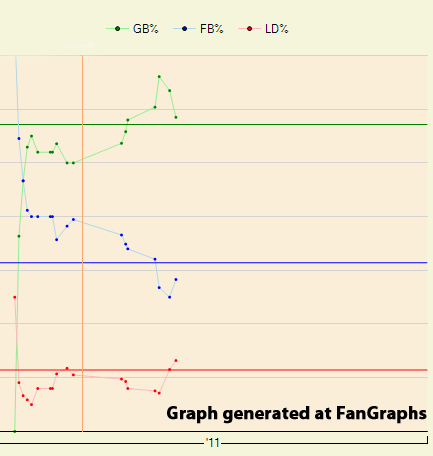
Returning to ground balls, Herndon’s improvement directly coincided with the amount of ground balls he was able to induce, as seen here in the this graph generated by the awesome Fan Graphs:
The Role Theory (Mop Up v. High Pressure)
This one you can throw out right away, mostly due to incredibly small sample sizes. However, if you didn’t throw it out right away, you’ll see that Herndon was equally effective and ineffective in both high and low pressure situations in his first round with the Phillies while he has been pretty effective since his first demotion in both scenarios.
The Sample Size Theory
This is the likely culprit and goes hand in hand with the regression to the mean theory. Herndon skipped Triple A to reach the Majors in 2010 and only pitched 52.1 innings in 47 games, which is relatively small sample size for a reliever in itself. 2009 was his first full season as a reliever and he pitched in 65.1 innings across 50 games for the Arkansas Travelers in Double A, compiling an effective 3.03 ERA, but allowing 1.9 BB/9 IP, 1.2 HR/9 IP, while only picking up 4.8 K/9 IP. While at Triple A Lehigh Valley in 2011, Herndon has put up impressive 1.2 BB/ 9 IP, 8.6 K/9 IP and a 7.0 K/BB ratio across 14.2 innings.These are all small sample sizes but indicate some measure of success.
The Final Verdict
David Herndon has been unquestionably significantly more effective since his first demotion on May 4, 2011. By inducing more ground balls, Herndon plays to his strengths and his seen his ERA cut in half and his WHIP sink. His BABIP becomes very important as he pitches to contact. At .275, he currently sits below the league average and has gotten a little luckier than his .357 BABIP of 2010. The key for Herndon maintaining the improvement are two things any Major League pitcher should strive for: continue to limit his walks and keep opposing hitters in the ballpark. As the sample size gets bigger, we will be able to tell if Herndon, at age 26 with many years left in his arm, will be a cog in the Phillies bullpen for the next few seasons.
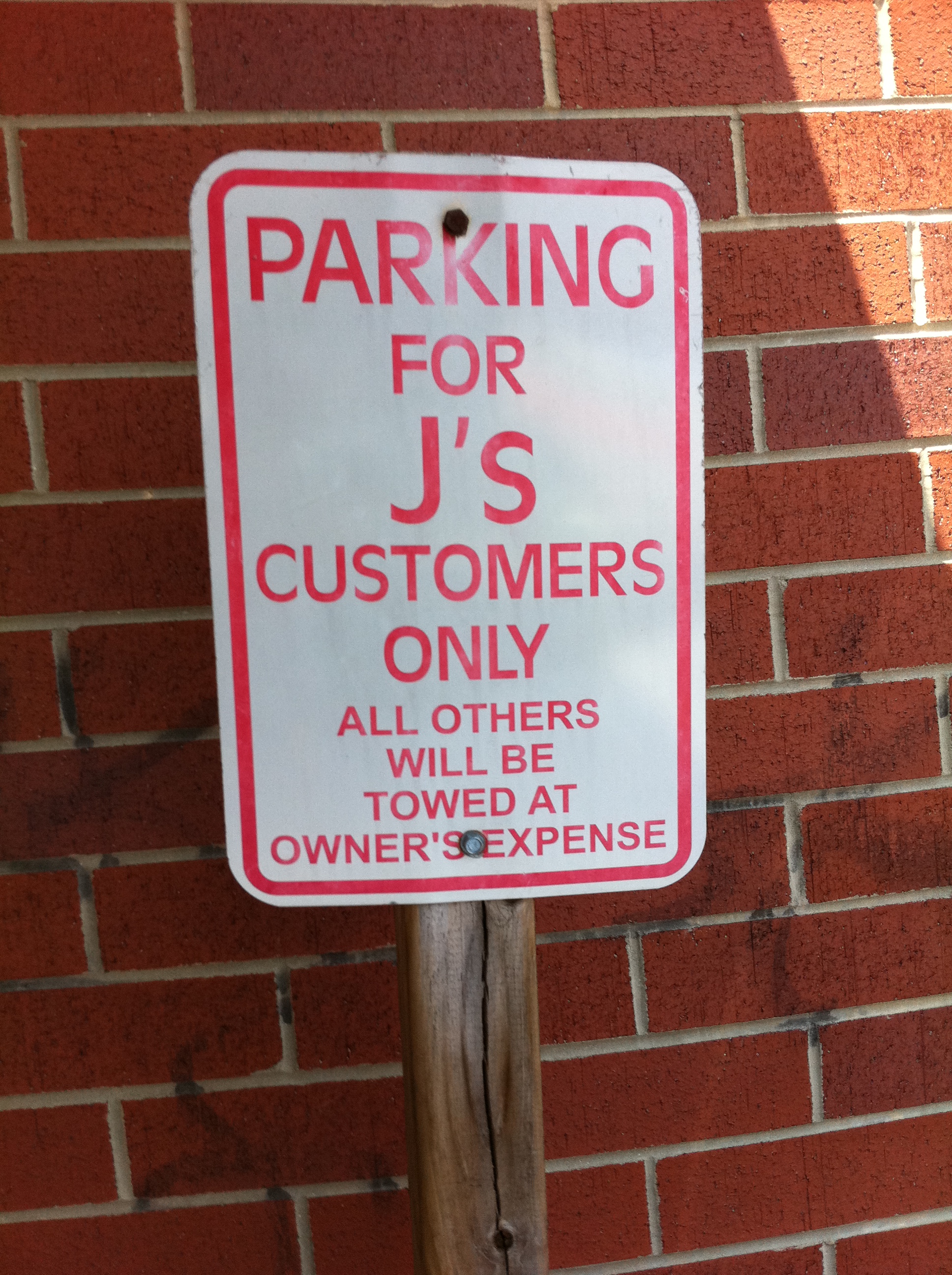
It could have said anything; J's Customers, J's Fans, didn't matter. I was eating there.
If you lived in the Lehigh Valley through the 1980’s and 1990’s, you were familiar with J’s Cheesesteaks and Subs. Amoroso’s rolls, or a very close imitator, book-ending fresh cold-cuts, cut thin, with stringy lettuce, ripe tomatoes, oil, vinegar, and I get mustard on mine. The cheesesteaks may even be better.
I didn’t stand a chance.
J’s was a 5 minute car ride from my house and on the way to and from every major childhood stop: my mom’s work, me and my brother’s middle school, my dad’s work, both malls, all three grocery stores we shopped at; we literally saw it every day. J’s, for reasons unknown to me, disappeared from my most convenient location, South Fourth Street, Allentown, PA, in or around 1999.
It’s bad enough that I’m already addicted to hoagies. I love the texture, the taste, the combination of deli meats, cheeses, mustards, oils, vinegars, and pickles. The stringier the lettuce, the better, and if the tomatoes aren’t neon red, don’t put them on my hoagie. On a random errand run to Quakertown, I took a back way home to kill time and there it stood, shining like a sign from God in the middle of Telford, PA. It was J’s and it was open.
My dad and I had already eaten so there was no way I was convincing the cheapest man ever to stop to eat a second time within two hours of eating the first time. But I did make a mental note
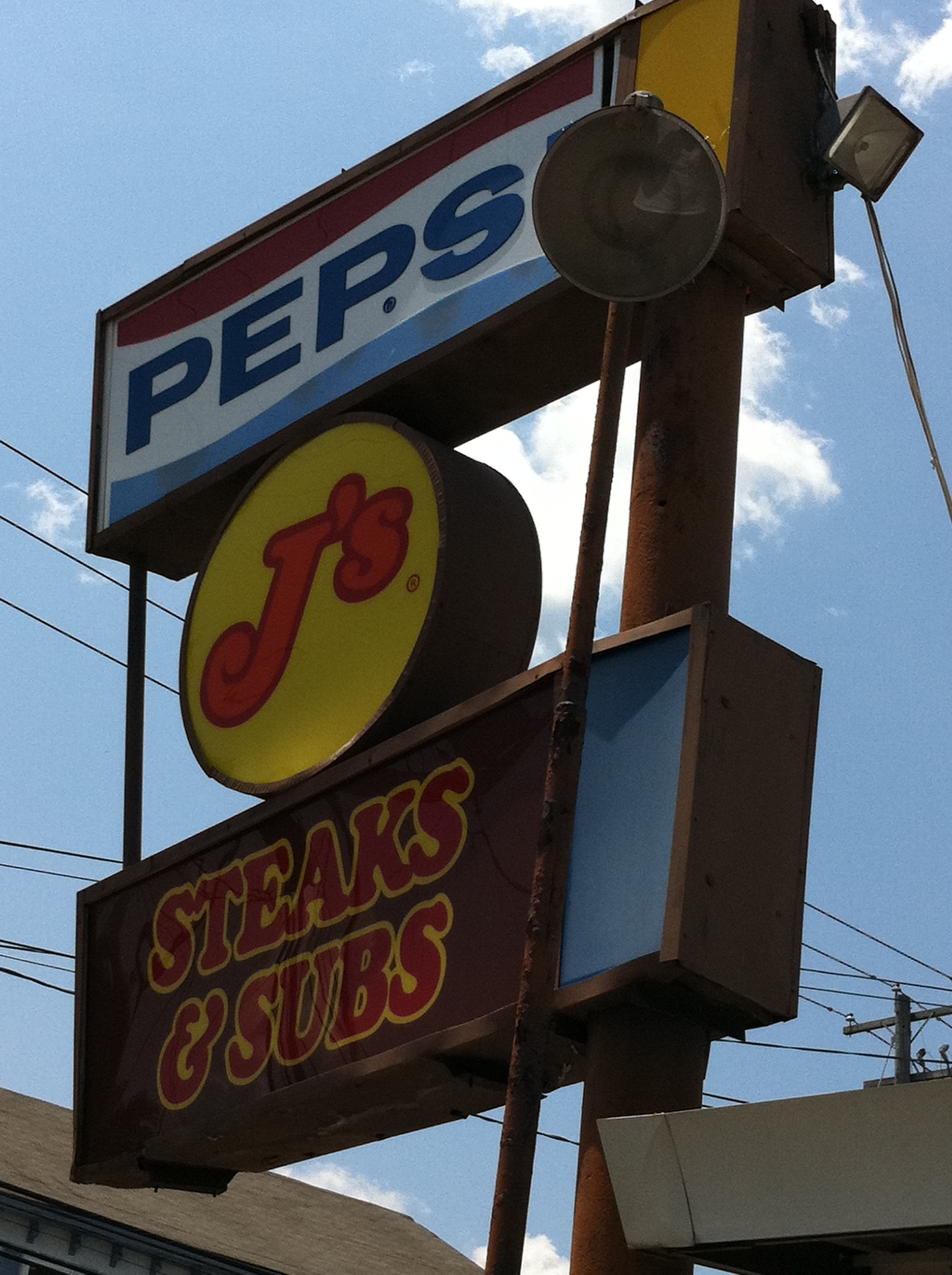
Like a lighthouse guiding me from Lansdale, the familiar J's logo means great hoagies and lots of fun memories.
of it’s location. A few days passed and it became an obsession. I was hyping it to my mom, telling my brother about it, and having dreams of dancing hoagies.
I had seen they have a Facebook page and, being my father’s son, I printed 2 copies of the 7 inch sub, small fry, and small drink for $4.99 coupon. We were headed for Telford.
I had a calorie deficit going into Wednesday but I didn’t want to binge. I needed to make a smart choice on the sandwich to offset eating the fried food. I knew going in that I was going to eat the fries. They were a small and the serving size while a great value was small enough that it didn’t make a dent in my healthy eating on a day where I was planning to cheat. The fries were very similar to Oreida Fries, which for one serving are 130 calories, 2 grams of fiber, 1 gram of sugar, 2 grams of protein, and 21 grams of carbs. Oreida’s facts list the serving as 11 fries; J’s gives you about 18. For argument’s sake, let’s say it’s two servings for 260 calories plus will throw in 140 more calories for whatever they’re frying it in, making it an even 400. Using Wawa’s nutritional information, I calculated what my hoagie would be since the products and ingredients used are very similar: 440 calories, 25 grams of protein, 2 grams of fiber, but 2850 grams of sodium, 450 more than the daily recommended value from the processed meats, cheese, and bread. The fries also had a tremendous amount of salt; in addition to the processed salts, they were salted after coming out of the frier. I wouldn’t hesitate to estimate there was at least 2000 mg of salt on the fries. To drink, I had water.
The meal was moderately high in calories even when choosing the healthiest sandwich on the board and only drinking water at 700 calories. But the taste. And the memories.
It is no hyperoble that when I say it tasted just like I remembered, if not even better. I savored every last bite. The juice from the pickles, the way the cheese interacted with the turkey, the salt from the fries. They had a crane game. An old, early 90’s cop shoot-’em-up, not unlike the N.A.R.C. machine that sat at the entrance to the que at South Fourth street. Even the restaurant smelled like the one on South Fourth Street! This was a dream come true. I just wish my brother Bill could have been up from Florida to share this with us.
I get excited over the little things. Here is a photo:
Two beautiful J's hoagies with fries. An Italian and my turkey hoagie, with Mom across the table.
Before I wax any further, the rest of the day was a success, minus the increasingly frustrating salt encounters. After lunch, I was at 1020 calories, 41 grams of protein, and 14 grams of fiber. Through the rest of the day, I had two plain Chobani’s topped with fresh blueberries, determined on Day 2 that two Chobani’s topped with blueberries “equaled about 220 calories, 36 grams of protein, a gram or two of fiber from the blueberries, and the added benefit of flavor and cutting about 80 calories per Chobani from the prepacked Chobani blueberry flavor thanks to erasing the sugar heavy blueberry mix they use.” And I also had my three protein shakes: one before my workout, one after, and one before bed. As established on Day 1, the three shakes total 550 calories and 120 grams of protein. 1020+220+550=1790 calories, with 177 grams of protein. For dinner, I had a natural peanut butter sandwich on Arnold’s Multi-Grain bread that was established on Day 1, which comes out to 620 calories with a little bit more than 30 grams of protein per sandwich, with about 10 grams of fiber. For the day, I was at 2410 calories, about 210 grams of protein, 26 grams of fiber, and super low levels of simple sugars.
Rules from day 1 that I followed:
Avoid simple sugars
Eat 4-5 times daily
Maintain a 1/1 ratio of grams of protein consumed to body weight lbs
Maintain high fiber levels
Drink, drink, drink water
Avoid any beverage with calories
Maintain 2000-2500 calorie diet
Rules from Day 1 I did not follow:
Avoid fried foods
Day 3 was a successful day even though I made a choice in eating the fries that was against my self-appointed rules. I maintained high fiber consumptions, I drank over four gallons of water, I avoided any beverage with calories, was in my 2000-2500 calorie range, I avoided simple sugars, I ate five times, and I consumed a gram of protein per pound of my body weight, which was 201 lbs at the start of the day. Wednesday was not a lifting day, so I spent 90 minutes on the elliptical on fat burn mode, burning just under 1,100 calories at a nice pace.
General observations:
Finding new ways to eat protein is very challenging; there is really only so much Greek yogurt and shakes I can consume. I may inject some cottage cheese into my diet, which includes slow burning cassein protein.
Finding ways to keep eating is challenging. When I eat right, or come close to eating really well, I am much fuller faster. The proteins and the fibers fill me up and I have to force myself to consume more protein.
It’s only Day 3, but I’m feeling better. My moods are better, my sleep is getting better, and my muscles aren’t as sore from exercise the next day.
I’ve made nice gains in my leg lifts and chest lifts.
I feel better when I’m at the gym. The positive decision to eat well for one me propels me to have confidence to work as hard as I can at the gym.
To see my previous two days, click the links below: